Back in 2021, I wrote about alternative app stores (also known as third-party Android app stores) and the importance of freedom of choice in the mobile ecosystem.
Five years later, we’re seeing another step in that direction.
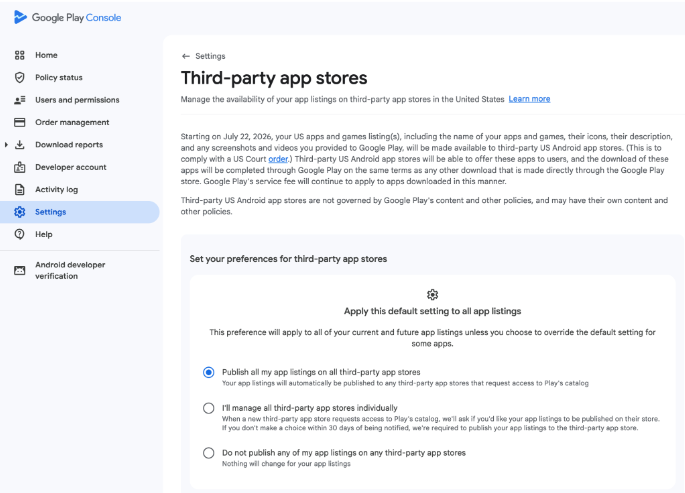
Starting July 22, 2026, participating third-party Android app stores in the United States will be able to access and display Google Play app listings, including app descriptions, screenshots, icons, and videos.
While this may sound like a minor technical change, it addresses one of the biggest challenges third-party Android app stores have faced for years: content.
Closing the Content Gap
Historically, alternative app stores have struggled with a classic chicken-and-egg problem.
Users expect a rich catalogue of apps and content before they engage with a store. Yet building and maintaining those catalogues requires significant developer participation, partnerships, and resources.
Google’s announcement helps close that gap.
Alternative app stores can now provide a more complete discovery experience without having to build every app listing from scratch. In practical terms, one of the biggest barriers to operating and scaling an alternative app store just became significantly smaller.
This does not guarantee success. Distribution, trust, user experience, and partnerships will continue to matter.
But it does make competition easier.
Why Marketers Should Care
The significance goes beyond app stores.
For years, app discovery has been concentrated around a small number of platforms. Today, discovery is becoming increasingly distributed across third-party Android app stores, OEM ecosystems, recommendation engines, and native on-device experiences.
The key takeaway is not that Google Play becomes less important. It remains one of the most important distribution platforms in the world.
The takeaway is that app discovery is becoming more diversified.
As users encounter apps across a growing number of environments, marketers should think beyond a single-store strategy and ensure they have visibility wherever discovery happens.
There is also a risk diversification angle that marketers should not ignore.
Recent events in the app ecosystem have highlighted how dependent businesses can become on a small number of distribution platforms. Whether a removal, policy change, ranking adjustment, or review decision is ultimately justified is not the point. The reality is that when a company relies heavily on a single storefront, a single platform decision can have a material impact on growth.
A more diversified discovery strategy helps reduce that dependency.
As alternative app stores, OEM ecosystems, and other discovery environments continue to mature, marketers have more opportunities to build resilience alongside growth.
This is one reason we believe OEM advertising should be part of every mobile marketer’s default growth strategy.
Search and social remain essential. But as app discovery expands beyond traditional storefronts, OEM advertising is increasingly becoming a default component of modern mobile growth strategies.
Today, AVOW’s OEM partner ecosystem reaches more than 1.85 billion daily active users and approximately 86% of the global Android market, highlighting the scale these environments already represent.
The Next Question: What About Europe?
The most interesting question may not be what happens in the United States.
It may be what happens next in Europe.
The Digital Markets Act has already pushed the mobile ecosystem toward greater openness. Yet content onboarding remains a challenge for many alternative app stores and OEM ecosystems.
If similar content portability requirements were introduced in Europe, alternative app stores could scale more easily, developers could reach additional distribution channels with less friction, and OEM ecosystems could benefit from a more streamlined approach to app availability.
Google’s latest announcement is US-focused.
But it may also offer a glimpse into the future of app distribution more broadly.
More choice.
More competition.
And more ways for users to discover apps beyond a single storefront.
For marketers, the question is no longer whether alternative app stores and OEM ecosystems matter.
The question is how much future growth they are willing to leave untapped.
About the Author